How future changes in irrigation water supply and demand affect water security in a Mediterranean catchment
JPC Eekhout, I Delsman, JEM Baartman, M van Eupen, C van Haren, S Contreras, J Martínez-Lopéz and J de Vente
I am actively developing a open-source coupled hydrology-soil erosion model (SPHY) to increase its applicability in Mediterranean environments. Model development include the implementation of a process-based soil erosion model, an ensemble of process-based soil erosion models, a morphodynamics module, and an irrigation module. The model is written in Python and makes use of the PC-Raster framework. The SPHY model has been used by a number of MSc and PhD students in which I acted as daily supervisor. Please contact me if you are interested in using the model or if you have suggestions for improvements. See the footer at the end of the page for contact information.
I’m currently working on the implementation of a conservation module, which bundles several conservation measures that we applied in previous studies. The conservation measures include land use change, soil improvements (changes in organic matter and bulk density), vegetation cover (cover crops and buffer strips) and retention structures (ponds and check dams). Land use change and vegetation cover allow to change the NDVI dynamically in the area where the measure is applied (only available when the Vegetation Module is used). Vegetation cover and retention structures are an integral part of the Soil erosion and Sediment transport modules.
An irrigation module was developed to determine irrigation water requirements within the SPHY model. The irrigation module is based on the Plant Water Stress curve and uses only one parameter (Management Allowable Depletion). For each crop the user can indicate between which dates irrigation is applied. The new irrigation module was tested in the Campo de Cartagena catchment (SE Spain), which is characterized by intensive irrigated agriculture. In a climate change impact assessment we showed how irrigation water requirements change in the future and how the changes in irrigation demand affect the land use distribution in the study area.
JPC Eekhout, I Delsman, JEM Baartman, M van Eupen, C van Haren, S Contreras, J Martínez-Lopéz and J de Vente
This is the first online SPHY manual developed by FutureWater. In this new version of the manual we included a description of the four new soil erosion models, i.e. DHSVM, HSPF, INCA and SHETRAN. In addition, we included descriptions of other recent changes to the SPHY model, like how to use NetCDF input and the new reporting csv-file implementation.
S Khanal, AF Lutz, JPC Eekhout, W Terink and WW Immerzeel
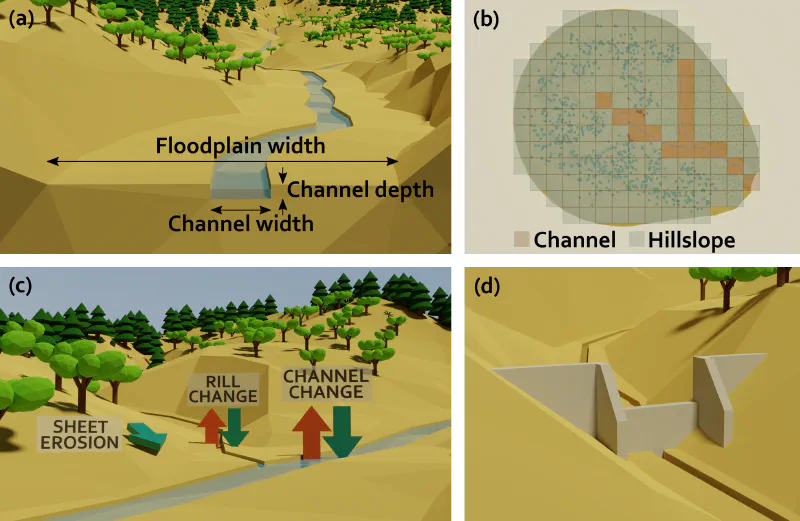
We implemented two new modules to simulate river hydraulics and morphodynamics. We added a new water routing module that makes use of the PCRaster travel time algorithm. Channel dimensions are required to use this new module, including channel width, channel depth and floodplain width. The new water routing module allows to generate typical hydraulic model output, such as water depth and flow velocity. In addition, we implemented 5 sediment transport equations that are forced by these hydraulic variables. Finally, we implemented a channel morphodynamics module that simulates erosion and deposition of the channel bed. The new channel modules were tested in a case study in the Taibilla and Rogativa catchments (SE Spain), for which an extensive sediment yield database was available. We showed that channel erosion has a significant contribution to the catchment-scale sediment balance.
JPC Eekhout, A Jódar-Abellán, E Carrillo-López, C Boix-Fayos and J de Vente
We implemented 4 additional process-based soil erosion models, so the model can be used as a soil erosion model ensemble. The additional models included DHSVM, HSPF, INCA and SHETRAN. These soil erosion models are similar to the MMF model, but have some important differences regarding the simulation of detachment by runoff and immediate deposition. Some models require more physical properties, like rill dimensions, or include a sediment storage in the deposition routine. The soil erosion model ensemble was applied in a case study in the Mula catchment (SE Spain), where we showed how differences in model concepts affect uncertainty in a climate change impact assessment.
JPC Eekhout, A Millares-Valenzuela, A Martínez-Salvador, R García-Lorenzo, P Pérez-Cutillas, C Conesa-García and J de Vente
The soil erosion and sediment transport modules were included in the SPHY manual on the occasion of the launch of SPHY v3.0. Our contributions included the theoretical background of the soil erosion and sediment transport modules, a description of how to use these new modules in your SPHY project and a case study highlighting their capabilities.
S Khanal, AF Lutz, JPC Eekhout, W Terink and WW Immerzeel
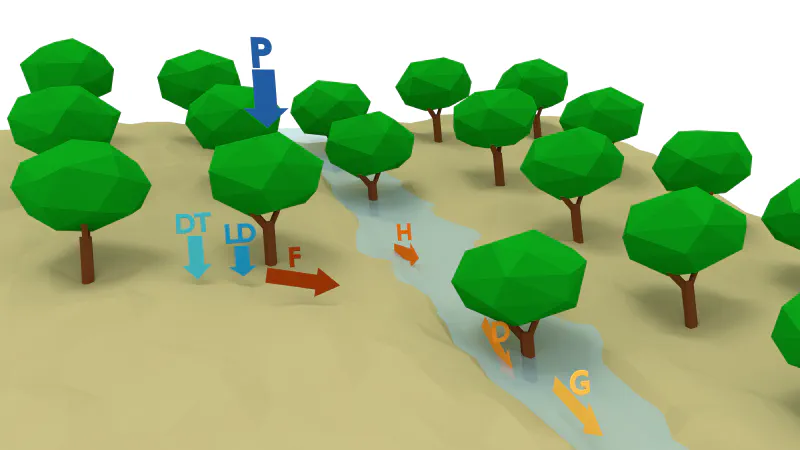
Initially, SPHY development focussed on soil erosion and sediment transport. The empirical Modified Universal Soil Loss Equation (MUSLE) was already implemented by previous developers. However, we had the feelint that this model did not agree well with the process-based nature of the SPHY model. Hence, we implemented the process-based Morgan-Morgan-Finney soil erosion model into SPHY. This model requires more input than MUSLE, but most model parameters are measurable which makes the application relatively easy. At the same time we also implemented a sediment transport module, to determine sediment yield at the catchment outlet or reservoirs. Soil erosion mostly occurs during extreme rainfall events when the rainfall intensity is often higher than the infiltration rate. Therefore, we also implemented a daily derivation of the Green-Ampt infiltration capacity equation to account for infiltration excess surface runoff.
JPC Eekhout, W Terink and J de Vente